By Michael Konrad
Maintenance of Everything: Part One
Stewart Brand 2026, Stripe Press
Amazon.com: Hardcover $33.42, Kindle $9.99, Audiobook $0.00
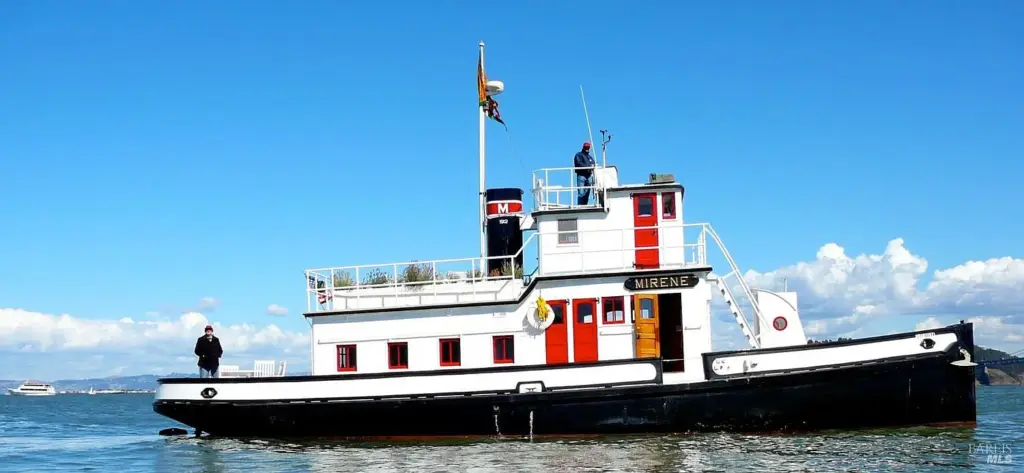
Stewart Brand and his wife, Ryan Phelan, lived on their tug Mirene at South 40 Dock for many years (shown above). Stewart became famous by creating The Whole Earth Catalog in 1968. He has subsequently published many books and journals, has started foundations, and launched an online computer community.
His recent book, Maintenance of Everything: Part One, reminds us that physical systems age, and except for wine and cheese, the process does not usually result in an improvement. As one example, he describes world solo sailing races in which the preparation of the boat and the skill of the sailor in repairing inevitable damage occurring during the voyage are far more important for success, and sometimes survival, than the ability to sail closer to the wind.
The Importance of Maintenance
In another example of the importance of maintenance, he compares the American M16 rifle to the Russian-designed AK-47. The sensitivity of the M16 to water, mud, and sand, and the complexity of cleaning and difficulty in reassembly resulted in the loss of many American lives in the Vietnam War. In contrast, the technical performance on the firing range of the AK-47 used by the Vietcong was inferior, but in the jungle the AK-47 rarely jammed, and if it did could be disassembled, cleaned, and reassembled in short order. These are just a few examples of the many interesting examples of maintenance described in the book.
An earlier book, How Buildings Learn: What Happens After They’re Built (Penguin Books, 1994) by Mr. Brand also discusses maintenance. He narrated a six-part television series, shown on the BBC, based on the book that was also titled How Buildings Learn. It is still accessible on YouTube. In this series, he lampoons several large buildings by famous architects for leaking roofs, sensitivity to solar overheating, inhospitable common spaces, and failure of exterior windows and cladding. He contrasts these to the supporting environment of the Sausalito houseboat community. You’ll love it.
The take-home lesson is that reliability and ease of repair when failure occurs can be more important than its initial performance or appearance. Stewart’s book contains many more stories that illustrate the importance of maintenance, and I highly recommend it for insights into this vital process. The subtitle Part One suggests that we can hope to soon hear more from Brand about a broader or deeper meaning of maintenance.
Here are two other examples of maintenance not described in the book.
The Maintenance of Information
Our modern Internet-device-media culture relies on information, but information is continually corrupted by random thermal noise, chemical aging, or physical wear. We are now dependent on computers, or computer-like devices, to manage data and control devices from our automobiles to smartphones. Computers require operating systems and programs to function. These programs must not contain errors because a random change in a computer program can prevent it from performing an essential function, or even worse, produce an instruction that cannot be executed, causing the computer to halt. In most cases, the operating systems need to be periodically updated with new programs sent over the Internet. What to do?
Information is maintained by a combination of duplication and error detection. Information is duplicated as soon as possible, and then the copy is used and periodically checked for errors. If the information is found to be damaged, the copy is copied and then used in place of the damaged information. Sophisticated error correction is also required to enable cell or smartphones to operate at acceptable distances from cell towers. Some error correction algorithms can correct most corrupted data without a retransmission.
Transmission Control Protocol (TCP) is commonly used for sending information over the Internet. It requires error detection information to be part of every packet it handles. When your device receives a TCP packet and determines it has not been corrupted, your device sends an acknowledgement message back to the sender. If the sender doesn’t receive this acknowledgement in a fixed time, it sends the same packet again. This cycle is repeated a preset number of times, and if a successful transmission does not occur, the sender is notified. The Internet is not perfect; it is just best effort, but you are informed that it failed.
The Maintenance of Life
Living organisms must also be maintained; at least they must function long enough to reproduce, or the species dies out. Maintenance is performed by a large variety of molecular machines that detect damaged cellular parts and repair or replace them. DNA encodes genetic information but accumulates errors from ultraviolet radiation and reactive chemical species in the cell.
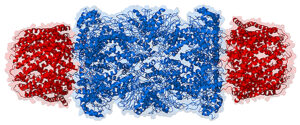
Several types of enzyme complexes move along the long DNA molecule and sense abnormal atomic structure, such as thymine-thymine dimers. As long as the complementary nucleotides are intact, the abnormal segment is excised and replaced with a complementary segment. Analogous systems sense damaged proteins, which are then tagged with a small peptide, ubiquitin, which marks them for removal by a large “garbage collecting” machine, the proteasome. New protein replacements can be made since the information is preserved in the DNA.
Proteasome has a molecular weight greater than two million, larger than the ribosome, which originally catalyzed the synthesis of the protein from amino acids. Malfunction of the proteasome has been linked to Alzheimer’s, Huntington’s, and Parkinson’s diseases (Wikipedia).