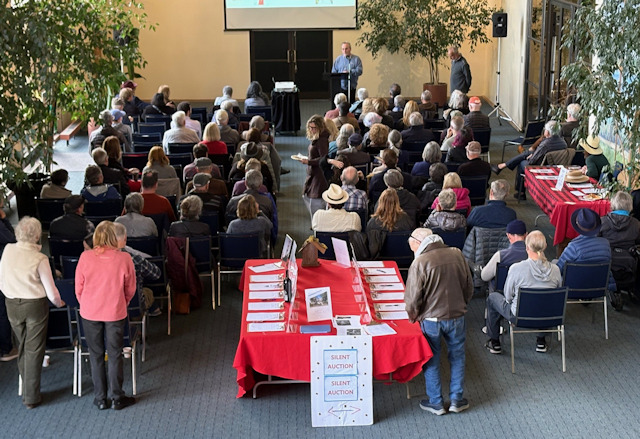



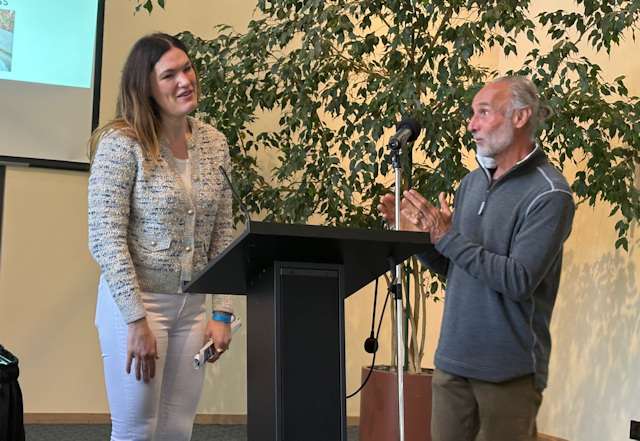

Breakfast at the Bay Model proved a popular format for the Floating Homes Association’s annual Membership Meeting on Saturday morning, February 21.
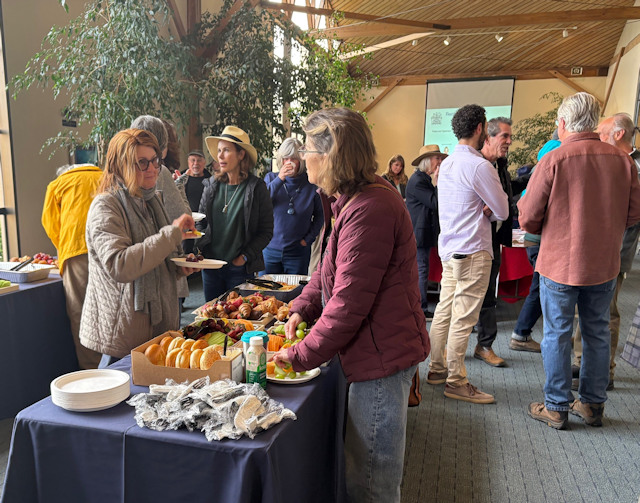
FHA Events Chair BettyAnn Kram and her team of volunteers set out a lavish buffet of bagels, muffins, quiches and fresh fruit. Firehouse Coffee rounded out the menu.
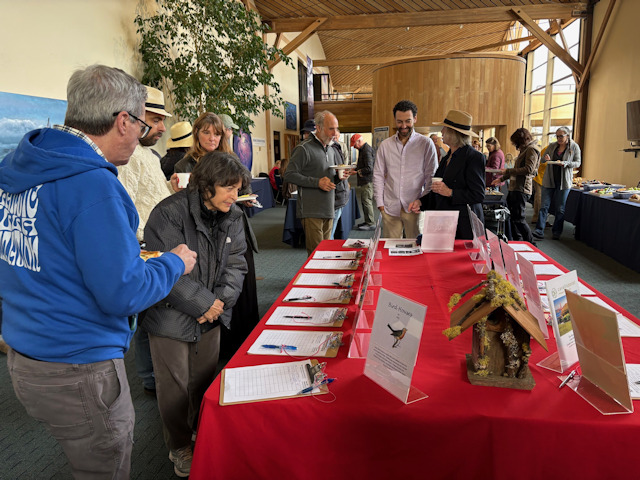
Susan Huxtable presented a table-full of silent auction prizes, which attracted $4,000 worth of bids.
Association President Peter Miller began the meeting by acknowledging the work of current and immediate past Board members, and called for volunteers to help with 2026 initiatives, such as private tours and Day in the Park, which is scheduled for May 17.
Peter also thanked the local enterprises that sponsored the meeting, including Premier Sponsor Bay Cities Refuse. He then introduced Bay Cities General Manager Greg Christie, who expressed his pride in serving our community and fielded questions about disposing of garbage, recycling and composting. The other sponsors were Engels & Volker Realty, Hawser Marine Insurance, and Compass Realty.
Recapping the major accomplishments of 2025, Peter commented, “It was a momentous year.” First and foremost was the passage of AB574, our amendment to the rent control law for flooding homes. Anna Shimko and Sasha Cole, co-chairs of the Legislative Action Committee, were honored as Members of the Year for their work crafting this legislation.
The FHA made an arrangement with A&R Plumbing to assist with the new Red Shield sump pump requirements. Two volunteer shoreline trash sweeps left us with a cleaner environment. In November, the Red Cross visited to check on smoke detectors, and 49 homes in the community were checked or replaced, the largest installation the Red Cross has done in Marin County.
Looking forward, Peter stressed the need for volunteers for various planned activities. BettyAnn Kram needs help planning and staging Day in the Park. Lewis Shireman seeks volunteers to help market and organize private tours, and Larry Clinton is recruiting for a replacement editor for the Floating Times ahead of his planned August retirement.
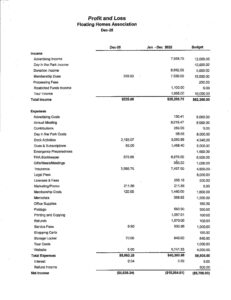
Interim Treasurer Tracy Corbin reported that the Association finished 2025 with a net loss of about $15,000. The FHA had budgeted for a loss of about $5,700, so the deficit was roughly $9,400 more than planned.
Income for the year was $25,000, which was less than half of the $52,000 that was budgeted. The largest shortfalls were membership dues, tours, advertising, and income that would have come in from Day in the Park, which was postponed until spring.
Tracy pointed out that donations came in slightly above the budget, which helped offset a small part of the deficit gap.
Total expenses were about $40,000, far under the $58,000 that was budgeted. At the end of the year, the cash on hand was approximately $4400. A full profit and loss statement is included at the end of this post.
Melissa Blaustein: “You are a thriving heartbeat of our community.”
Featured guest speaker Melissa Blaustein, vice mayor of Sausalito, had high praise for the floating homes, stating: “you are a thriving heartbeat of our community, and when people ask about or hear about Sausalito, one of the first things that they ask about or mention is the houseboats.”
She pointed with pride to the City Council’s decision to open up municipal boards and commissions to participation by citizens of zip code 94965, not just those residing within City limits.
Melissa also expressed admiration of the eclecticism of the floating homes community, noting, “there’s such a diverse makeup of different kinds of people: old-timers, new-timers, CEOs, techies, salties; everybody’s in the same place, and everybody loves it.”
Another facet of waterfront living which she praised was our tradition of mutual support, which was evident during the king tide flooding over the New Year’s weekend. In response to reports that 10 cars were totaled due to salt water flooding, she noted that the Council had declared an emergency that the Small Business Administration can address with low-cost loans for repairs and financial losses.
She also discussed the City’s efforts to address flooding and sea level rise, pointing out, “The reality is that making these improvements, whether they’re longer term or shorter term, is really going to require a lot of partnership, from the state and local governments to bring funding, and from property owners like you to make improvements on the ground here in Sausalito.”
On the subject of Marinship, Melissa noted, “People often refer to it as sort of a third rail of politics in this town, which I’m used to in my role on the Council.” She then discussed the need to approach zoning and improvements in that area to address sea level rise as well as the ongoing housing crisis. “The reality,” she stated, “is the rules we put in place in this area are over 40 years old, and while everything else has moved forward, areas here are being left behind and unimproved. Everyone on the Council cherishes the working waterfront and protecting it is a priority, but I’m someone who believes in a both-and approach, where we partner with working waterfront and property owners in our community so we can all benefit as a result.”
The next day, the Marin IJ reported that Sausalito was planning to revisit a controversial 1985 ordinance limiting the working waterfront’s development.
Melissa is in charge of the task force that’s driving discussions around affordable housing projects and invited input from waterfront residents.
She closed her prepared remarks by reporting on changes around the downtown ferry plaza. An outdoor piano is being installed on Tracy Way and the Council is working on a busking ordinance that will allow musicians to perform in that vicinity.
During a lively question and answer session, Melissa sympathized with concerns from the community about the Bay Conservation and Development Commission’s lack of action on issues such as housing demand and flood control. “BCDC was started with a really great mission,” she acknowledged, “and they did a lot of amazing work to reopen the waterfront and to clean our bay. But now, ideas like adding additional piers or floating piers for floating homes, or extending marinas to allow more waterfront housing are being stopped by BCDC.” She noted growing concern among city officials all around the Bay to pressure the Commission to become more cooperative.
The meeting ended before noon and 100 or so well-fed, well-informed residents returned to our fabulous lifestyle.